
You've probably heard that you should eat 1 gram of protein per pound of body weight. It's the most repeated protein rule online, and for most people it's more than they need. Here's what the research actually says, and a simple way to get there without counting every gram.
Note: Most research gives protein in grams per kilogram of body weight. I've converted everything to grams per pound to simplify the conversation and make it easier to track your protein goals.
Why protein is worth your attention
Your body uses the protein you eat to build and repair itself. It's part of your:
Muscle. Protein helps you keep and build muscle, which keeps you strong and steady as you age.[4][5]
Bone. Protein makes up about a third of bone weight, mostly collagen. Eating enough is linked to slightly denser bones, though it hasn't been shown to prevent fractures.[11]
Brain. Your brain uses amino acids from protein to make neurotransmitters. For example, tryptophan becomes serotonin, which helps regulate mood and sleep, and tyrosine becomes dopamine, which drives motivation and focus.
Hormones. Some hormones, like insulin, are made of protein.
Fullness. Protein is the most filling of the three macronutrients, so it helps you feel satisfied after a meal.
Immune system. Antibodies, which fight infection, are made of protein.
Skin, hair, and nails. Their structure is built from the protein you eat.
Why there is little agreement on protein targets
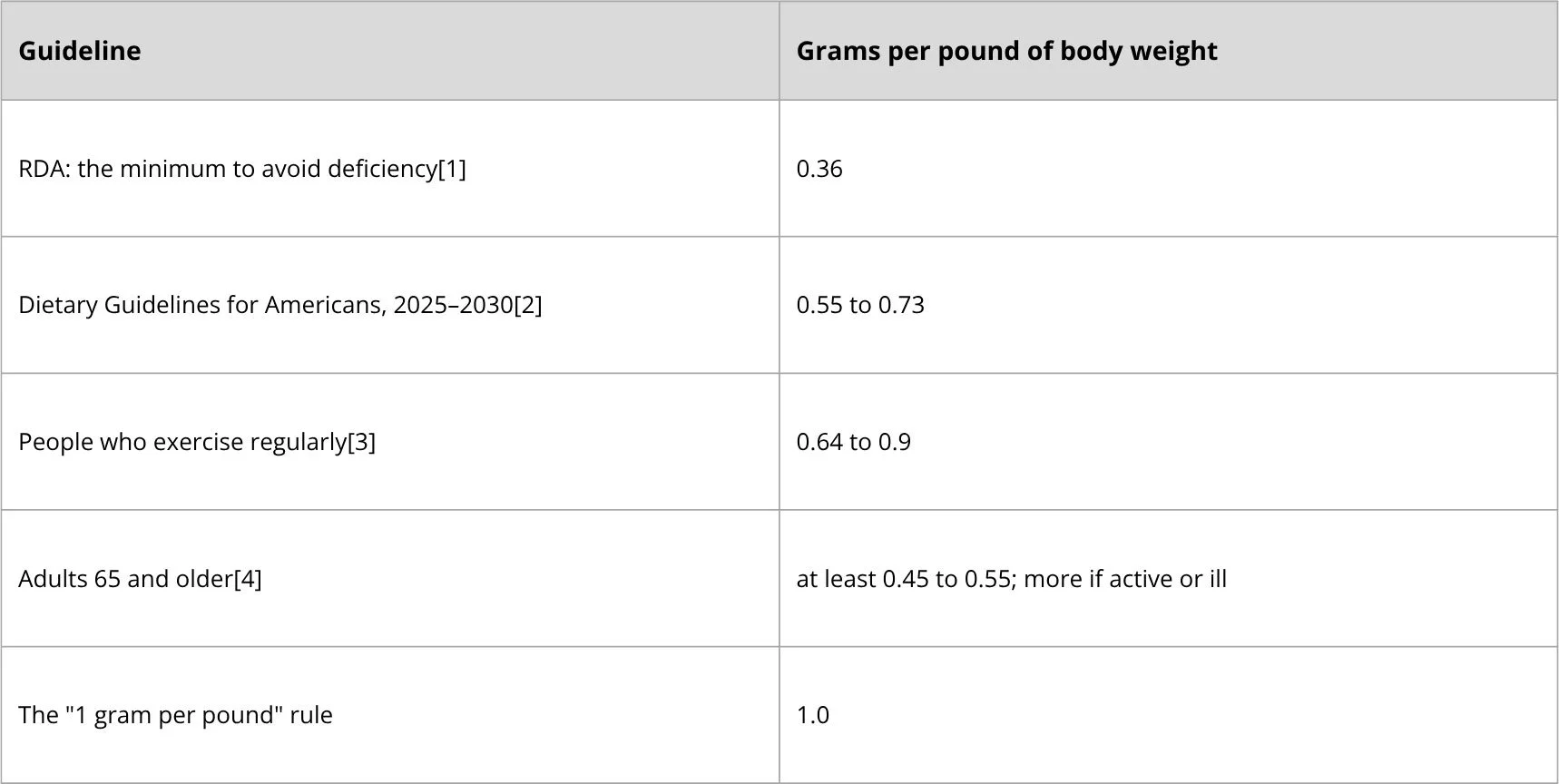
Protein guidelines vary depending on who they're written for and what they're trying to achieve. Here's how they compare.
Note:
The 1 gram per pound rule comes from bodybuilding culture, and it rounds up to the very top of what research supports. Why has it stuck? Likely because it's simple: one gram, one pound, no tricky math required. But for a 150 lb woman, it means 150 g of protein a day. That takes real effort, can crowd out other nutritious foods, and is more than most people need to build muscle. A large review of 49 studies found that the muscle-building benefits of protein level off at about 0.7 g per pound, or about 110 g for that same woman.[5]
The RDA number is a floor, not a goal. It was set to prevent deficiency, not to support strength or healthy aging, which is why the newer guidelines land higher.[2]
What this means for you
For most people, the sweet spot is the Dietary Guidelines range: 0.55 to 0.73 grams of protein per pound of body weight. That's enough to maintain muscle, and the top of that range is about where extra protein stops adding muscle gains for people who strength train.[5]
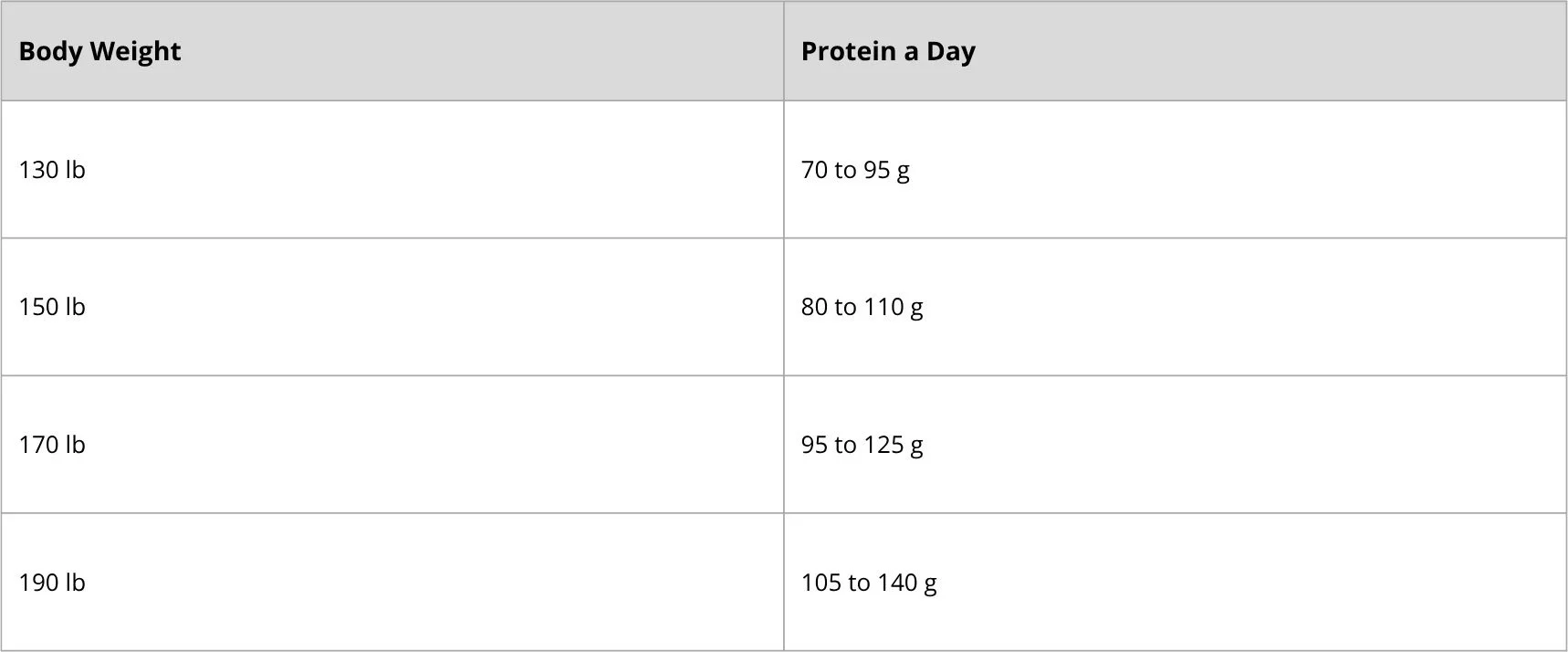
Use your current weight, not a goal weight. Where you land within your range depends on a few personal factors.
Accounting for bio-individuality: women, men, stress, and age
Women and men. Per pound, the numbers are the same. But women eat less on average, about 66 g a day versus 89 g for men, so they're more likely to fall short.[9]
Stress. Illness, injury, and surgery all raise protein needs.[4] Everyday stress hasn't been studied enough to set a target. On busy, stressful weeks, the simplest goal is not to skip meals, since protein quietly drops off when you skip.
Age. As we get older, muscle responds less to the protein we eat, so it takes a bit more to get the same benefit. Appetite often drops too.[4] In practice, aim for the higher end of your range, about 30 g per meal. Researchers define "older" as 65 and up, but muscle loss starts earlier, so it's worth paying attention from about 50, especially through menopause.
Strength training. Protein works best with a reason to build. Lifting weights or doing resistance work two or three times a week signals your muscles to use the protein you eat.[5] Protein without that signal does much less.
Menopause and other special cases. The research is thin, and no separate target has been set. Aim for the Dietary Guidelines range, and check with a professional if you're unsure.
How to hit your targets
A daily total can feel overwhelming, so think in meals instead:
Aim for 25 to 30 g of protein at breakfast, lunch, and dinner.[3] Stay closer to 25 g if you're less active, and closer to 30 g if you're very active, older, or under a lot of stress.
Treat a snack as a booster. An apple with 2 tablespoons of peanut butter, or half a cup of shelled edamame, adds another 8 to 9 g toward your goal.[10]
Three meals at 25 to 30 g plus a snack gives you roughly 85 to 100 g. That lands most people at 130 to 150 lb in or near their range.
If you weigh more than 170 lb, train hard, or want to lean toward the higher end for personal reasons, add a second snack or aim for 35 to 40 g at one or two meals.
Does timing matter?
Maybe, but don't stress about it. One study found that spreading protein evenly, about 30 g per meal, raised muscle-building activity over 24 hours compared with loading it into dinner.[6] Other studies are mixed, though, so your daily total matters most. Spreading it out is simply an easy way to reach that total.
Pro-Tip: Breakfast is the meal most people can improve, and a protein-rich breakfast with some fiber is one of the best ways to keep hunger and energy levels steady until lunch.
When to check with a professional
In healthy adults, higher protein intake hasn't been shown to harm the kidneys.[7] If you have kidney disease, are pregnant or breastfeeding, are underweight, or are recovering from illness, ask your doctor or a registered dietitian for your number.[1][7]
Key Takeaways
Protein helps you keep and build muscle, supports bone, and supplies the building blocks for hormones and brain chemicals.
The "1 gram per pound" rule is a gym rule of thumb. Research supports less for most people.
Aim for 0.55 to 0.73 grams per pound of your current weight: about 80 to 110 g a day at 150 lb.
Think in meals, not daily totals: 25 to 30 g at breakfast, lunch, and dinner, with a snack as a bonus. This is a good target for most of us.
Adjust up or down depending on training schedule, stress, and individual goals.
Don't chase an exact number at every meal. Your daily total matters most, and the research on timing is mixed.
No single food has to deliver your protein. Grains, vegetables, nuts, and seeds all count toward your daily goal.[8]
Women and men need the same amount per pound. Needs rise with age, so pay attention and adjust as you age.
Strength training helps your muscles use the protein, so the two work best together.
If you have kidney disease or are pregnant or breastfeeding, get individual guidance.
Sources
Institute of Medicine. Dietary Reference Intakes for Energy, Carbohydrate, Fiber, Fat, Fatty Acids, Cholesterol, Protein, and Amino Acids. National Academies Press; 2005.
U.S. Department of Health and Human Services and U.S. Department of Agriculture. Dietary Guidelines for Americans, 2025–2030. January 2026.
Jäger R, et al. International Society of Sports Nutrition position stand: protein and exercise. J Int Soc Sports Nutr. 2017;14:20.
Bauer J, et al. Evidence-based recommendations for optimal dietary protein intake in older people: a position paper from the PROT-AGE Study Group. J Am Med Dir Assoc. 2013;14(8):542–559.
Morton RW, et al. A systematic review, meta-analysis and meta-regression of the effect of protein supplementation on resistance training-induced gains in muscle mass and strength in healthy adults. Br J Sports Med. 2018;52:376–384.
Mamerow MM, et al. Dietary protein distribution positively influences 24-h muscle protein synthesis in healthy adults. J Nutr. 2014;144(6):876–880.
Devries MC, et al. Changes in kidney function do not differ between healthy adults consuming higher- compared with lower- or normal-protein diets: a systematic review and meta-analysis. J Nutr. 2018;148(11):1760–1775.
Lim MT, et al. Animal protein versus plant protein in supporting lean mass and muscle strength: a systematic review and meta-analysis of randomized controlled trials. Nutrients. 2021;13(2):661.
U.S. Department of Agriculture, Agricultural Research Service. What We Eat in America, NHANES 2021–2023.
U.S. Department of Agriculture. FoodData Central. fdc.nal.usda.gov
Darling AL, et al. Dietary protein and bone health: a systematic review and meta-analysis. Am J Clin Nutr. 2009;90(6):1674–1692.